Your Location:

Texas

Arizona

Roof Rat Infestation: Causes, Symptoms and Solutions

A roof rat infestation is a problem no homeowner wants to have. Roof rats are a common type of rat that get their name from their tendency to seek shelter in the upper part of buildings. They are smaller than a common subway rat, which allows them to sneakily gain entry into your home. Don’t let the name deceive you – roof rats can also be found in other parts of your home and in outdoor spaces. If you are a homeowner, it is important to be aware of roof rats, the problems they cause, how to prevent an infestation, and how to get rid of a roof rat infestation. 

How Do Roof Rats Get Into Your Home? 

Roof rats are naturally gifted climbers and prefer having their nests up high. They are known to use tree limbs, vines, and power lines to climb up and get into homes. In some cases, roof rats can also climb directly on your exterior stucco to gain entry into your home. While roof rats are not as small as mice, they are able to easily get into an opening that is about the size of a quarter. Generally, roof rats seek shelter in homes for protection from predators and to look for food/water sources.

Are Roof Rats Harmful? 

Roof rats are harmful to your health and home, so if you have an infestation, it is something you should take care of immediately. 

A roof rat infestation can detrimentally affect your health. They carry fleas and also diseases such as typhus, infectious jaundice, rat-bite fever, and trichinosis. If you have them in your kitchen, they can also cause food poisoning by contaminating food or counter spaces where you prepare food.  If you want to learn more about the harmful effects of roof rats on your health, The University of Arizona published a paper discussing the pathogens they carry.

Roof rats also harm your home. They gnaw on wooden structures such as wood beams and other important parts of your home. Roof rats also chew on pipes, trample down on insulation, and chew on wires. If they get to your electrical wires or pipes, roof rats can cause many hazards and damage to your home.

How do I know if I have Roof Rats? 

If you have a roof rat infestation, and require rodent proofing services, there will be signs. You won’t usually see the roof rats as they are nocturnal, but as they forage for food, they will leave signs of their presence. 

The most obvious sign that they leave are droppings, which are about 0.5 inches long. If you come across these, you should clean them up immediately using a strong disinfectant since their droppings are known to spread disease.

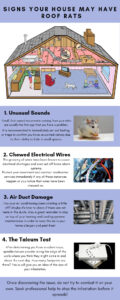
Other signs of a roof rat infestation include gnawing or scratching noises in the attic or walls, damage to electrical wires from gnawing, hollowed out fruit if you have fruit trees in your yard, the presence of nests in the insulation of your home, and gnaw marks around your home’s roof. If you have a dog or cat, the presence of roof rats will likely cause them distress and agitation. If your animal starts randomly acting strange and you’re noticing gnaw marks around, it is likely you have a rodent infestation that could be roof rats.

If you are seeing signs of a roof rat infestation, call a trusted exterminator immediately. Once roof rats are inside your home, the population is known to grow quickly. A female roof rat can have a litter of 5-8 babies up to 3 times a year. 

How to Prevent a Roof Rat Infestation

No home is immune to a rodent infestation, which is why it is important to take precautionary measures to avoid having roof rats come in and completely disrupt your home. To prevent an infestation, you should look for and seal up any holes or cracks that are larger than a quarter. Additionally, all windows and vents should have screens on them so that the rats can’t sneak through. Since roof rats are very adept climbers, you will want to ensure your trees and shrubs are trimmed away from your home so they do not have easy access to your space. It is also recommended to eliminate sources of water that the rats would be attracted to such as leady sprinklers, birdbaths, and leaky pipes.

Another important aspect of rodent prevention is to be mindful about food they may be able to access. Roof rats are always searching for food sources, so as your first line of defense make sure any fruit that has fallen from trees is cleaned up and your garbage cans are tightly sealed. Inside, you should ensure dry food and pet food are in sealed containers so that the rodents cannot access it. 

Some people use ultrasonic repellents to deter rodents like roof rats from entering their homes. Essentially, these devices emit a high-frequency sound that is extremely distressing for rodents but does not bother humans and most pets. If you have a hamster or guinea pig, be mindful about where you place this device so you are not causing them any harm. 

How Do I Get Rid of a Roof Rat Infestation?

If you are seeing signs of a roof rat infestation, we recommend calling a trusted exterminator in your area who can conduct a home inspection and come up with an infestation treatment plan for your home. 

If you are more of a DIY person, there are certain actions you can take to get rid of the infestation. You can use a bait and trap method to get rid of your roof rat infestation. It is recommended that you use dried fruit, nuts, berries, peanut butter, or an item such as dental floss that is an attractive nesting material. One thing to note is that you should avoid setting traps and placing food in the attic of your home as it could have an unintended effect of attracting more roof rats.


Best bet would be avoiding traps and food in the attic, only at extreme situations you should place traps in attic only to find the rats entry point to the attic Because roof rats are cautious creatures, to lure them into the trap, it is recommended that you put out the bait for a few days without setting the trap so that they trust it as a safe food source. 

For traps, you have the option of a traditional snap trap (you know the one) or a more high tech electronic trap. The electronic traps are considered to be more humane as they use a high-voltage shock to take out the rat. Electronic traps are a great option because they are reusable, easily disposable, they have a blinking light that indicates a rat is in there, and most importantly, they are safe to use around pets and kids.

Once you have gotten rid of the roof rat infestation, sanitize everything and follow the roof rat prevention tips recommended by experts and enjoy your roof rat free home.

How to Get Rid of Rats in Your Attic

It might start with the soft sound of little feet. Maybe you hear scurrying overhead one night or see teeth marks and rodent droppings on the edges of the furniture you have stored in your attic space. Pretty soon, all the signs point to the same conclusion—you have a rat infestation in your attic.

With the wide array of traps, poisons, and other rodent-removal tools on the market, it can be difficult to know how to start tackling a house mouse problem. Should you try to tackle the problem yourself with an old-fashioned mouse trap and cheese to take care of your mouse infestation? Or is this a job for a pest control professional.

In this short guide, we’ll explain the best rodent control methods for rat removal, proofing, and prevention. 

How Do I Know If I Have Rats In My Attic?

It can be challenging to know whether rats in your attic are the culprit for the noises you hear at night. But it’s important to confirm the source of your problem, as a family of raccoons or squirrels may require a different pest-control solution. Understanding how to get rid of squirrels in the attic can be different than taking care of a rat or mice infestation. 

Rats are nocturnal and usually shy, so you may never actually see a live rat in your attic or home. Instead, you should look for the signs that point to the unwelcome visitors.

The following are all signs that you have rats in the attic:

  • You hear scratching or scurrying sounds 
  • You notice scraps of hair or mouse droppings
  • There is a noticeable smell

However, it’s best to consult with a pest or wildlife removal specialist to confirm that rats are actually the source of the issue.

How Do I Get Rid of Rats?

No one likes sharing their home with rats. Aside from being off putting, rats spread diseases and cause property damage, so it’s essential to address your rat problem right away. 

Once you’ve confirmed that rats are truly the issue, there are three crucial steps to get rid of rodents in your attic. 

Step One: Exterminate 

*Something to note: Although we are recommending extermination as the first step to getting rid of rats, here at Attic Construction we can easily work in attics with live rat activity and still garner fantastic results. 

There are several different methods of getting rid of rats. But not all methods are created equal. Certain extermination solutions are better to ensure you’re protecting nearby wildlife, your pets, and children in your household. 

When you’re researching how to get rid of rats in attic, you’ll likely encounter the following products:

  • Live traps – This type of rat trap consists of a small cage. It is called a live trap because the animal is kept (as the name suggests) alive. Although this might seem more humane than killing them, relocating animals may leave behind orphans, and relocated animals rarely survive.
  • Glue traps – These can be as simple as a tray coated in a sticky adhesive. Unfortunately, they are an ineffective and inhumane method of pest control. Large rats can pull themselves free, and those that do get caught suffer prolonged, painful deaths from exhaustion and dehydration.
  • Snap traps – Old-fashioned traps use a bait station to attract rats. Then, a spring-loaded bar comes down and kills the rodent instantly. Snap traps are an effective and humane way to deal with rodents—if you can actually get them interested in the bait. Since rats are highly intelligent, they know to avoid unfamiliar objects. They might also have a nearby food source that is more enticing than testing the snap trap.
  • Rat poison – It is best to exercise extreme caution when using this method yourself. Otherwise, you risk accidentally harming children, pets, and local wildlife.1 A qualified pest control professional can lay out poison bait in areas of minimal risk to other creatures.

Whichever method you use, it is vital that you kill 100% of the rats in your house. Rats breed extremely quickly—a single female can have up to 5 litters a year. If any individuals are left alive, your rat problem will be back in no time at all. 

If you are uncomfortable with killing rats or simply want to make sure the job is done right, you should consider professional rodent removal.

Step Two: Keep Rats Out

The most important step to getting rats out of your attic is to prevent them from getting in. Your attic is warm and dry and filled with lots of prime nesting material. Rats see your attic as an inviting place to settle down and have a family, and they will do anything they can to get in.

Roof rats, the pest most likely responsible for your home’s infestation, are incredibly agile and excellent at breaking into your home. They can run up power lines, scale buildings, jump up to four feet, and squeeze through any hole larger than a quarter. They can even chew through wooden doors and windows to gain access to your house2.

So how can you keep them out?

Rat-proof your attic.

To rat-proof your attic, you’ll need to find 100% of the paths rodents are using to get in. You should cover any holes larger than a quarter with rat-proof material such as sheet metal. If this seems daunting, check out the rodent proofing services from Attic Construction.

Step Three: Decontaminate Your Attic

Congratulations, you’ve gotten rid of your rat population! But—your work is not over yet. Here’s why there’s still a few things left to do before you can breathe a little easier:

  • Though the rats are gone, evidence of their presence certainly isn’t. Rat feces and urine left behind after an infestation may aggravate allergies and cause diseases such as salmonella and the potentially life-threatening hantavirus.3 
  • Rats can chew through walls or even electrical wiring, creating fire hazards and power outages.

Decontamination is best left up to professionals with protective equipment. 

Reclaim Your Home With Help From Attic Construction

You might not spend much time in your attic, but that doesn’t mean you want to find rat feces amongst your holiday decorations!

While solutions like glue traps and snap traps can feel more affordable in the short-term, you need a long-term solution to your rat problem.

At Attic Construction, we have highly trained professionals ready to decontaminate your attic and make your home safe again. Likewise, our attic-proofing services ensure that critters of all sizes will stay out. Get in touch with us today to schedule a free consultation.

Sources:

  1. Pennsylvania Game Commision. Rodenticide Toxicity. https://www.pgc.pa.gov/Wildlife/Wildlife-RelatedDiseases/Pages/RodenticideToxicity.aspx
  2. CDC. Disease Vectors and Pests. https://www.cdc.gov/nceh/publications/books/housing/cha04.htm


How Do Animals Get in the Attic

Have you heard scratching or moving in the walls and ceiling of your home? Or have you noticed unpleasant or stale smells? Perhaps your pets have been paying close attention to your walls and ceiling. These are all common signs that you may need rodent proofing as rodents are actively making a home in your attic.

While you might have an affinity for wildlife, you probably also recognize that having pests make their home in the unfinished spaces of your home like your attic, walls, or crawl spaces is not ideal. In fact, a rodent infestation that is allowed to become established can bring with it harmful diseases and cause thousands of dollars worth of damage. 

How Rodent Infestations Occur

How do animals get in the attic? The answer is that pests like rodents and mice gain access to your home through small gaps in the exterior. The reality is that small pests can gain access to your home through a gap as small as ¼” for mice or bats. Rats can pass through mesh wires larger than ½”.

Rats, squirrels, opossums, and other pests are opportunistic when they are looking for a place to nest. Your attic and the other unfinished spaces of your home offer a dry place that is safe from predators. If you have trees or tall bushes that have grown close to your roof it can offer easy access to an unsecured grate, holes, or small gaps in a vent. If you are dealing specifically with squirrels, you can also read further on how to get rid of squirrels in the attic.

It’s not just trees or bushes that can attract critters to your home. Trash near your home can provide an easy meal source. Piles of leaves or yard waste can offer an attractive nest to rodents who haven’t already made their way into your home. If you haven’t yet, it’s a good idea to take some time to ensure your yard and the areas around your house are neat and tidy.

Despite your best efforts, you might find yourself a victim of a rodent infestation. Don’t worry, it can happen to anyone. Remember, it only takes a ¼” gap for mice to gain access to an area, so the exterior of most homes are vulnerable. However, it is important to understand how to recognize a rodent infestation and what steps to take with animal control to ensure you deal with it before it becomes a bigger issue.

What To Do Once an Infestation Occurs

Rodents and pests are a persistent problem, and unless you have taken steps to rodent-proof your home you are vulnerable to a rodent infestation. Once a rodent colony has established itself, it can be difficult to deal with.

One of the first steps is recognizing that an infestation has occurred. The early signs of a rodent infestation may be subtle and can go unnoticed. Common signs of an infestation are:

  • Scratching noises or moving in the walls. 
  • Stale smells from accumulated urine, feces and animal waste
  • Evidence of nesting materials such as insulation or shredded paper. 
  • Rodent droppings. 

Ideally, you’ll prevent an infestation from occurring before it happens, but dealing with one after the fact is possible. If you suspect you have a rodent infestation, it’s important to call professionals to assess the situation and outline remediation such as decontamination, insulation removal, and new attic insulation installation.

For most infestations, the first step is to prevent further access. This involves rodent-proofing the exterior of your home so that pests can’t enter. It may also be a good idea to trim any shrubs or trees that are providing the rodents with easy access.

Effectively rodent-proofing means more than simply trimming bushes or trees back. Every access point on the exterior of the home will have to be assessed and covered if necessary, using mesh and other materials that are rodent resistant and safe for your electrical wiring. 

Once you have secured the outside of your home it’s time to clean up the remnants of the infestation. Rodents love to use insulation as nesting material, so cleanup may involve the removal of damaged insulation. Once any contaminated materials have been removed from the attic it can be decontaminated and new insulation can be installed if necessary.

Final Thoughts

Animals can make their way into your home through any number of avenues. Usually, they do so through small gaps in the exterior of your home, such as near vents or between your eaves. Pests like mice and rats only need tiny gaps in your exterior to gain entry, and they can often overcome physical barriers if they aren’t constructed with rodent-resistant materials. 

Once a rodent infestation occurs, it’s important to contact professionals like Attic Construction to solve the problem. The first step is to deny further access to your home, which means rodent-proofing the exterior of the home. Then it is important to thoroughly decontaminate the space and reinstall attic insulation if any were damaged.

While dealing with a rodent infestation isn’t ideal, catching one early can help avoid costly repairs. If you suspect you have a rodent infestation you should strongly consider having an inspection done. Even if you haven’t seen signs of an infestation, an inspection can help highlight gaps in the exterior of your home. Addressing those weaknesses early can help you prevent rodent infestations before they occur.

To learn more about dealing with animals in your attic or to schedule an inspection, please contact Attic Construction today.

Attic Construction is a well-established company that has been providing attic services from different locations. So, whether you are searching for an insulation installation in Phoenix or attic cleaning in Orange County, we got you covered.

Sources:

  1. https://www.houselogic.com/organize-maintain/home-maintenance-tips/attic-pest-removal/
  2. https://www.epa.gov/rodenticides/identify-and-prevent-rodent-infestations
  3. https://sfenvironment.org/sites/default/files/fliers/files/final_ppbd_guidelines_12-5-12.pdf 


How Much Will Rodent Infestation Cleanup Cost?

How Much Will Rodent Infestation Cleanup Cost?

You’ve heard squeaking and scratching sounds coming from your attic, and now you’ve even seen a live rodent scurrying around your house. You called a rodent control company and they’ve confirmed your worst fears – you have a rodent infestation. So how much will the rodent removal and rodent infestation cleanup cost? And, is it really worth the investment to have the job handled by professionals?


Nowadays we can buy traps and rat poison online, so you might think that investing money in a professional rodent control and cleanup company is a waste of money. However, you can’t put a price on your family’s health, and if your cleanup and rodent control efforts aren’t done correctly you can put your family’s health and safety at risk.


So how much is a rodent control and clean up going to cost you on your bottom line? Well, it’s complicated, but it mostly depends on:

  1. the size of your attic

  2. the extent of the damage done.


However, these costs are absolutely necessary and there are ways to justify these rodent infestation cleaning costs.


Damages Determine Cost

Rodents can cause serious damage to a home. Rodents tend to destroy the area they build their nests in. Additionally, all rodents need to gnaw on things to wear down their teeth. In a home, this means that everything from wooden doorframes to attic insulation to electrical wiring could be damaged during a rodent infestation.

The damage done to your home during a rodent infestation, as well as the size of the active rodent infestation in your home, will determine your rodent infestation cleanup cost.

Frayed electrical wiring can put your home at risk of catching fire. Depending on the extent of the damages, you may need to hire a professional to patch or replace damaged wiring in your home. The same goes for your attic insulation. Rodents like to build their nests in attic insulation, which can completely destroy the insulation in your home. If your attic insulation is damaged or contaminated, your insulation will need to be cleaned and decontaminated or, in some cases, removed and completely replaced.


Rodent Infestation Requires More Than Normal Cleaning

Rat problems are much more than a nuisance – rodents carry a wide variety of dangerous, highly contagious diseases including hantavirus, hemorrhagic fever, salmonella, rat bite fever and typhus. In addition to this, rodent droppings, dead rodents, and urine are a breeding ground for germs and bacteria. All of this means that regular attic cleaning will not be enough to restore your home to a safe, healthy environment. Hiring a professional cleaning and decontamination team with specialized equipment and successful track record of handling rodent infestation cleanup is the best way to ensure that your come is completely decontaminated.[/vc_column_text][/vc_column][/vc_row][vc_row][vc_column][vc_single_image image="5018" img_size="600×250" alignment="center" onclick="custom_link" link="https://atticconstruction.com/contact-us/" css=".vc_custom_1556746674406{margin-top: 50px !important;margin-bottom: 50px !important;}"][/vc_column][/vc_row][vc_row][vc_column][vc_column_text]

SAN DIEGO RESIDENT DISCOUNTS –  858-609-8118

If you are dealing with a rodent infestation, contact the rodent proofing specialists at Attic Construction today. Our technicians are happy to answer your questions about what our attic cleaning costs, and will provide you with FREE initial home inspection and estimate!

[/vc_column_text][/vc_column][/vc_row]

How Do You Know When It’s Time to Do Some Rodent Prevention? 4 Signs to Watch Out For

If you are suspicious of a rodent problem in your home, there are many tell-tale signs that can alert you to the issue and let you know it’s time to consult a professional rodent exterminator. Catching a rodent problem early is the best defense to preventing an infestation. Take note of the following signs of mice and rats in your home and call a professional to help with rodent control, extermination, and home protection services:


1. Odors and Droppings

Mice and rats have differently sized droppings, but both look like foreign, dark pellets. Fresh droppings are shiny, while old droppings will be dry and crumble. If you’re seeing clusters of small, dark droppings in certain areas, that is an indication of a rodent runway. These pathways are the spaces where the rodents are frequently moving around your home. Mice and rats typically use ledges, cabinets, space near shoe molding, along walls, or piping to move about the room to try to avoid detection. Placing traps near these spaces makes it easier to catch and control the rodents in your home.

In addition, you may smell the musky odor of rodent urine. When a few mice have turned into an infestation, the scent is easily detected in a home and can be difficult to eradicate until the rodents have been eliminated. Be sure to thoroughly clean your home for both urine and droppings when your rodent problem is under control.


2. Pet Behavior

If you have pets in your home, they may exhibit skittish behavior or may be prone to barking with no provocation. They also spend time investigating, sniffing, or pawing at spaces under furniture, appliances, and around shoe molding. Your pets are clued into the unwelcome house guests, and a change in their behavior is an indication that something is amiss in your home.


3. Noises

Rodents are often heard before they are seen. While many people associate squeaking noises with mice, you’ll hear scampering first, especially in a home with hardwood floors and exposed vents. Since mice and rats are nocturnal, and you’re more likely to hear these noises at night. If a rodent is attempting to gain entry or gnawing on structures to keep teeth short, you may hear a sound that resembles scratching.


4. Chew Marks

When you pull a packaged food out of a cabinet and see a hole in the side of the bag, there’s a very good chance you have a mouse in your home. Any food item that is not sealed in impenetrable plastic can fall victim to rodents. But less conspicuous chew marks on wood in your home, like on baseboards, corners, and furniture can also be the first sign of rodents. Look for unusual wear and tear on wood in your home, and check food for signs of tampering.  


Rodent Prevention Techniques

If you think you might have a problem with mice or rats, hiring a rodent removal company is an important step to protecting your family from unwanted guests and the issues that accompany rodent infestations. But don’t forget to prevent your home from future infestations. The best way to avoid a rodent problem is to seal entry points before rodents can enter your home and to get a regularly scheduled attic cleaning to avoid attracting them.

Attic Construction in San Diego, Orange County and Phoenix is an insulation installation company that can help protect the most vulnerable place in your home – the attic. Mice and rodents are great climbers and find entry points where there are holes or not enough insulation. Get a quote today for rodent proofing services.

The Hidden Dangers of a Rodent Infestation


4 Signs Your Home Has Roof Rats

If you have mice or other rodents in your attic or crawl space, you’re familiar with the pitter-patter sound of feet on a wood floor. This is often your first indication of a rodent infestation, as your attic might already have several living in the residence. It’s important to block entry and quickly eradicate the population before it causes damage to your home or cause stress for your family. Here are a few hidden dangers of having rodents in your home:

1. Structural and Electrical Damage

Mice love to burrow, chew, and not only damage electrical wiring, but to the foundation and other structural features of your home as well. Also, rodents often create nests in places like air conditioning vents. If you begin to hear them moving around through the vents and walls too, especially at night, this could be a sign that your rodent problem is becoming widespread.


2. Disease and Odor

Rodents have historically caused wide-spread disease, take the European Bubonic Plague for example, and rodents still carry several very harmful diseases that humans can be susceptible to, such as salmonella. Both airborne and fecal bacteria can cause health problems for those who share space with rodents.

There’s also the issue of odor. If a rodent dies in a hard-to-reach area, your entire home will smell of decomposition. This is extremely unpleasant and is often caused by using poison to eradicate the colony. When a mouse eats a poison pellet or gel, it may take time for the animal to die. Wherever they’re living or hiding, they often die in that space, causing an unpleasant odor for several weeks. That being said, it is important that rodents are not only poisoned or trapped, but removed from the space as well.


What You Can Do to Prevent an Infestation

There are several substances and household items that attract mice. First and most obviously, mice are attracted to food that is easily accessible. To prevent this, seal all food in plastic or air-tight containers. Second, mice actively look for supplies that can be used for a nest, such as loose paper, cloth, tissue, and even cardboard. Keeping a tidy residence is essential to preventing a rodent infestation. If you suspect your home is susceptible to mice, your best defense is using plastic totes or off-site storage, rather than cardboard boxes or styrofoam, which can be easily shewed-through.


Defense: Rodent Proofing

As previously mentioned, there are two essential defense systems we recommend you use when rodent-proofing your home: sealing and eradicating.

First, seal all entry points. It’s important to consult a professional who can help you identify areas where the mice may be occupying, as mice can fit through a hole as small as the size of a nickel. While your first instinct may be to patch up ground and basement-level holes, your attic is also an essential area of your home to proof for rodent infestation. Pay close attention to areas of your roof that are close to tall plants or gates, as rodents may be able to climb and jump from them.

Second, trap the mice that remain in the home. There are several different types of solutions, including snap traps, sticky traps, and no-kill traps. While unpleasant, this is a necessary step to keeping your home rodent free.

Lastly, tidy-up clutter your home. You’ll likely find droppings in your living area. Throw away any food that shows evidence of mouse tamperings, like chew marks on boxes or bags.


Attic Construction

If you’re in the market for rodent decontamination services for your attic or crawl space cleaning service, check out Attic Construction in San Diego, an insulation installation and rodent proofing service. Specializing in repairs, installation, cleanup, and more, Attic Construction are experts in ensuring your home is adequately protected from mice and other rodents. Contact us for more information and a quote for rodent prevention or attic insulation services.

Why Having Rats in Your Home is Dangerous

Rats: they have been the nuisance of the human race since the beginning of civilization. How did this ensue? Well, rats have learned that by living near human beings, they have a plentiful food supply and a safe shelter to have their families. While rats themselves might not be diseased, they often carry bugs and parasites that are lethal to humans. Rats often get into our food supply and can diffuse those ailments to us incidentally. They can also indirectly harm us by living in such a near proximity that it gives the bugs a chance to attack our homes.

In addition to health apprehensions, rats in your attic can cause lots of complications for homeowners. Some common issues that ascend with the presence of rats in the home are: rats nesting in the walls and attic, scrabbling sounds that are irksome, munching on electrical wiring which can cause fires and prowling the kitchen pantry which can spread ailments and parasites to humans via their feces and urine. If you are having any of these concerns, it is vital that you get rid of the rats in your home immediately before the problem gets shoddier. For this, it is always advisable to opt for a rodent control company.

If you need a professional to perform attic maintenance or have questions regarding attic insulation installation or insulation removal, Attic Construction is here for you. We provide services to help homeowners with insulation related needs including rodent proofing, new insulation, attic cleanup, old attic insulation removal and more. For further information, please visit us atticconstruction.com or give us a call at 858-239-4805.

Rat Control For All

The leaves are changing, the weather is turning cooler, and you are getting out your favorite sweaters. It’s fall ya’ll! For many of us, that means we give our yard one good rake and mow, and then retreat to the indoors for a pumpkin latte. But while you’re carving pumpkins and decorating for halloween, spookier things could be going on. Creatures that scurry and gnaw are restlessly creeping are your home, looking for a way in.rat control

The outside of the home gets a great deal of attention during the summer months when you are watering flowers, doing exterior home maintenance or yard work. But come fall, the exterior of the property can often be neglected. The seasonal demands of outdoor upkeep are not as critical, but a lapse in attention to your outdoor premises can be costly.

With temperatures steadily dropping, and cool nights coming on, outdoor pests and critters will be seeking viable options for warm shelter during the fall and winter months. Rats are sneaky, determined creatures that will gnaw through just about any material (even metal!) to gain access to your home.

Garages, sheds, attics, basements, are all favorite rat nesting places. You don’t want to be cozied up inside by the fire only to hear the scratching sound of a rodent crawling around inside your walls! Talk about disturbing. Not to mention the potential havoc they can wreak- chewed electrical wiring, a ransacked pantry, disease-carrying droppings.

Now more than ever, vigilance is necessary to keep pests out! Rodent proofing should be a top priority during fall. What is rodent proofing, exactly? Rodent proofing is the process of changing the structure of buildings in order to prevent entry of rats and mice. Don’t feel daunted, rodent proofing isn’t extremely complicated or difficult.

Follow these key steps to successfully keep rats and rodents out this fall and be sure to remove debris.

The leaves have fallen and they may be obscuring parts of your exterior walls. A general once over with the leaf blower is just not enough to uncover collections of leaves that rodents may use to hide in.

BEST PRACTICES FOR PREVENTING UNWANTED RODENTS

The best practice is to clear all leaves away from the house. Rake carefully and thoroughly, right up against the walls. This could even become a chance for a  fun family chore! The important thing is to be able to see the foundation of your home.

Anything else that you may have against your home- compost piles, or wood piles for example – have got to go too! Sure, it’s convenient to have them right near the back door or against the house for easy accessibility. But pests have been known to hide in these piles. These spots will collect standing water and provide a water source that will sustain rodents. Imagine going to your wood pile, picking up a piece, only to find a rat scurrying underneath!

There’s just no telling if the exterior of your home behind the pile has been compromised. Many times, when you move the wood or compost pile, you’ll find a gnawed rodent hole in the siding or foundation behind it. Don’t leave anything to chance. You want to be able to have a clear view of every inch of your exterior to search for possible entry points.rat control for fall

RAT-PROOF YOUR HOME THIS FALL

Find all potential entry points

The most productive thing you can do to rat-proof your home during fall is to do a thorough sweep of the outside of your home and identify any possible entry points. You may be wondering, what exactly am I looking for? It’s simple actually. Any crack, hole, or tear in the outside walls.

If you live in an older house you are more likely to have a whole host of vulnerabilities.These are commonly found in weathered siding, worn exterior vents, loose or damaged roof shingles, gutters, even foundation. You know, all of those things go unnoticed or neglected over the years!

As you walk your property, carefully inspecting and seeking out weaknesses, take your time. This is not a step you want to rush! No crack or crevice is small enough to be dismissed. Rats can squeeze through a hole that’s just ½ inch wide! In fact, for peace of mind and a trained eye, your best bet is to consult with professionals. Team up with Attic Construction and get a high-quality inspection inside and out.

Seal all gaps leading into the home

The best way to keep rats out is to effectively stop them from getting in. Believe it or not, you do have the power to do just that. With the right tools and know how you can seal the exterior of your home, making it an impenetrable fortress against rodents!

Once you’ve located all potential risk spots (everyone’s got a few), it’s essential that they are properly sealed to keep rodents out. There is a certain way sealing has to be done. DIY quick and easy fixes can be tempting, but realistically, they aren’t effective or viable options. Duct tape, patching with plywood, and other cobbled together projects may be cheap, but will ultimately be a waste of time and effort.

In no time you’ll find that your handiwork has been gnawed through by rodents. And you’ll be searching inside your home for rats instead of outside.

Rats can chew through a surprising amount of materials! Plastic and aluminum to name a few. The following materials  are considered rodent resistant:

  • Sheet metal (26 gauge or heavier).
  • Perforated metal (24 gauge or heavier with openings no more than ¼ inch).
  • Hardware cloth (19 gauge or heavier with openings no more than ¼ inch).
  • Brick with mortared joints.
  • Cement mortar (1:3 mixture).
  • Concrete (1:2:4 mixture).

The professionals at Attic Construction use a technique for sealing these holes with steel mesh or metal flashing which rats cannot chew through. They follow that with a treatment of polyurethane sealant to stop air flow, which prevents rats from smelling for gaps that they can chew through. It also protects from the gnawing edge.

A gnawing edge is the edge of any sealed area which rats could potentially try to chew through. It is essential that the gnawing edges get protected with rodent-resistant materials. Places to rodentproof carefully for gnawing edges are doors, windows, holes where pipes enter buildings, ventilation holes in foundations, roof vents, exhaust fans, and leave vents.

The first two weeks after sealing entry points are critical. After completing rodent-proofing, searching and sly rodents will try to find breaks in the rodentproofing. To protect your investment and your handiwork, Inspect frequently during these weeks and repair any needed breaks asap.

Go with the pros and rats won’t even be able to sniff out a weak spot in your home’s exterior. No matter how new or old your home is, you can achieve equally excellent rodentproofing conditions by following these steps.

This fall the best defense is a good offense. Don’t let your home fall victim to rodent infestation. You can practice effective rat control by teaming up with skilled experts.  Attic Construction l has all the best tools and methods, as well as a friendly competent team. We also provide attic insulation installation for those who need insulation replaced. The feeling of safety, security, and confidence is what you’ll get when you invest in quality rat proofing. You have all the knowledge and resources you need to rodentproof your space, get started today!

Are You Ready to Get Your Free Estimate?

[Schedule Your Free Estimate]

When To Call For Rat Control – Recognizing Infestation

Being able to recognize the many signs of rodent infestation is important. Rodents are nocturnal, so you might not actually see a rodent in your home even if you have an active rodent infestation. If you notice any of these things happening in your home, be sure to call a professional rat control service to come and inspect your home right away to see if you have a rodent infestation:


Rodent Droppings – You will typically find rodent droppings anywhere near where rodents are eating or nesting. Rodents produce a lot of droppings and if you have an infestation it is likely you will find them all over the house. Common places to see rodent feces includes attics, along walls, on top of wall studs/beams, in old boxes, and in kitchen cabinets.


Squeaks And Grinding Sounds – Rodents aren’t quiet. They like to grind their teeth on wood which can cause loud scraping noises throughout your house. If you’ve been hearing animal noises you can’t explain, like squeaks, rustling and scampering sounds you might have rodents living in your home.


Urine Trails – Rodents have weak bladders that cause them to leave trails of urine all over the home. Mice sometimes make what are called “urinating pillars” around the home. These “pillars” are mounds of grease, dirt and urine.


Nests – Rodents love to build nests in warm, soft materials like fabric or attic insulation. They will usually look for sheltered, out-of-the-way places like attics and crawl spaces to build their nests. If you notice ripped up fabric or insulation along with rodent droppings you may have just stumbled upon a rodent nest.


Gnaw Marks – All rodents need to gnaw in order to wear down their teeth. Rodents love to chew on wood, but if no wood can be found they will gnaw on whatever is closest. If you suspect you are dealing with a rodent infestation, be on the lookout for rodent teeth marks on wooden door frames and chewed, frayed electrical wiring.


Grease Marks – Rodents are flexible and can squeeze through holes that are only as big as a quarter. Often, when they squeeze through these tight spaces they leave behind dirty grease marks. Look for these along your walls and baseboards and report any holes you find to your rat control technician when they arrive to inspect your home. These holes might lead to nests or provide rodents access to your home.


Overly Excited Pets – If you have a pet and your cat or dog seems extra excitable, they could be detecting rodent intruders.


Rodent infestation can endanger your family’s health and cause significant damage to your home as well. If you’ve noticed these signs, call a professional rat control service right away and be sure to get your home inspected.


Call Attic Construction


For more information about rat control or crawl space cleaning services contact the rodent proofing specialists at Attic Construction today by calling 858-609-8118.

Rodent Control Methods

Rats and mice like to breed and nest in the small, secret spaces of your home like your attic or crawl spaces. By the time you notice they’re there, you may already have a full blown rodent infestation on your hands. Rodent infestations are difficult to get rid of. Rodents are masters of hiding out of sight in walls, they breed quickly, and are flexible enough to fit through holes in your walls and baseboards the size of a quarter. Because of this, rodent control professionals need to use a combination of several rodent control methods in order to not only rid your house of rodents, but to prevent them from coming back.


Rodent Control Method #1: Traps


  • What Are Traps? Rodent traps do exactly what their name implies, they trap rodents. Traps come in all shapes and sizes depending on the type of rodent infestation you are dealing with and the severity of the infestation. A rodent control specialist will know the best places to set traps in your home based on your rodent activity.
  • How Do Traps Work? There are several types of rodent traps. Regular traps include things like snap traps and glue traps, both of which aim to kill the rodents. Snap traps are traps with a very powerful spring inside. These traps are set with bait and snap closed quickly killing the rat. Glue traps are a powerful sticky fly paper that can be placed anywhere. When rodents run across the glue trap they get stuck and either starve to death or can be removed from your home by a professional. Humane traps, are traps that simply trap rodents without killing them. These traps are like big cages. As soon as a rodent enters the trap the door shuts, trapping it inside. Once you’ve captured a rodent you can pick the trap up by its handle and remove the rodent to wherever you plan to release it.
  • The Trouble With Traps. Rodents breed quickly making rodent trapping a full-time job. As soon as you trap some rodents, there will be more. Rodent trapping does nothing to prevent future re-infestation of your home.


Rodent Control Method #2: Poison


  • What Is Poison? Rodent control professionals use poison to kill the active rodent population in your home. It is the most commonly used method by pest control companies to shrink an active rodent population.
  • How Does Poison Work? Rodent poisons, also known as rodenticides, comes in several forms, but pellets are the most commonly used. These poisons are anti-coagulants, meaning they kill the rodent by causing massive internal bleeding.
  • The Problem With Poisons. Rodents have to ingest several doses of poison for the poison to actually work. Because it takes so long to work, poisoned rats often die in hard to reach places in your home, like inside your home’s walls, causing foul odors and exposing your family to harmful bacteria and diseases. Leaving poison around your home can be especially dangerous if you have children or small pets.


Rodent Control Method #3: Rodent Proofing


  • What Is Rodent Proofing? Rodent proofing is the only permanent way to eliminate a rodent infestation in your home. During the rodent proofing process, skilled rodent control technicians find and seal all rodent access points in your home to block rats from getting in and prevent future infestations.
  • How Does Rodent Proofing Work? Rodent proofing happens in 3 stages. First your home is inspected and all rodent entry access points are located. Then all of these access points are sealed using a combination of professional grade sealant and steel mesh. Lastly, the infested areas of your home are completely cleaned, disinfected and deodorized to restore your home to a healthy environment.


Call Attic Construction


For more information about rodent control, contact the rodent proofing specialists at Attic Construction today by calling 858-609-8118. Our technicians are happy to answer your questions and will provide you with FREE initial home inspection and written report!

Free Inspection

"*" indicates required fields

This field is for validation purposes and should be left unchanged.
Address